
Application Performance Monitoring(APM)

  • Home
  • Application Performance Monitoring(APM)
We Simplify IT Ecosystem Complexity

Ditch the black box and take control of your application performance with Applications Manager’s suite of Enterprise application performance management tools, a comprehensive solution for monitoring, diagnosing, and optimizing application performance. Obtain deep visibility into user interactions with your distributed applications, identify bugs in your code, and resolve problems before they impact users with AI-powered anomaly detection.

Here's how Applications Manager can work for the different stakeholders in your organization:
DevOps teams

Streamline release cycles and reduce time to resolution with instant incident alerts and root cause analysis. Proactive monitoring ensures your applications remain resilient and dependable.

Site Reliability Engineers (SREs)

Ensure exceptional user experience by proactively identifying and resolving issues before they impact customers. Secure your applications and build trust with robust monitoring practices.

Product Owners

Make data-driven decisions about your applications based on real-time performance metrics. Prioritize features and enhancements that deliver maximum value to your customers.

Cloud Ops

Optimize your cloud infrastructure and reduce costs with granular insights into resource utilization. Applications Manager seamlessly integrates with leading cloud platforms for unparalleled visibility and control.

IT Operations

Gain real-time visibility into infrastructure health and performance. Automate repetitive tasks and focus on strategic initiatives that drive innovation.

780x520
290x220 1
Dive deep into every aspect of your applications:

Monitor every facet of your business applications, from servers and databases to networks and user interactions. Gain a holistic view of performance and identify bottlenecks hindering your application's full potential.

Understand how individual components contribute to overall performance. Pinpoint inefficiencies and optimize resource allocation for maximum impact.

Monitor user activity metrics like session duration, page views, and clicks to understand user engagement levels. Measure user satisfaction levels with Apdex scores.

Accurate error identification is crucial for rapid incident resolution, optimizing application performance, and delivering exceptional user experiences. Applications Manager's advanced diagnostic tools help you pinpoint issues with laser precision, ensuring flawless application performance.

Unmask the culprits behind unexpected application crashes and cryptic errors. Get information on the errors and exceptions thrown during application operation.
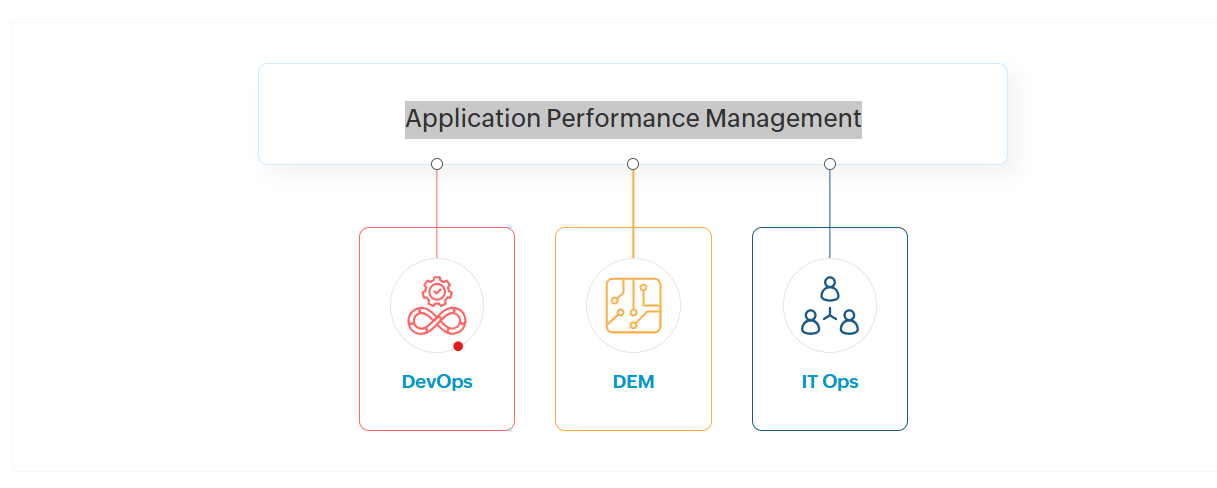

The operations of IT teams can be primarily divided into three:
Application performance management in DevOps

While traditionally focused on production environments, extending application performance monitoring (APM) practices to the development phase offers significant advantages. Early integration of application performance management within the DevOps toolchain unlocks actionable insights that propel application performance and stability, while simultaneously reducing development time. This proactive approach aligns with DevOps best practices, empowering teams to iterate faster, deliver higher-quality applications, and optimize resource utilization. By working in tandem with existing application performance management systems, this DevOps monitoring strategy strengthens the entire DevOps and SRE ecosystem, fostering continuous improvement across testing, management, security, and CI/CD pipelines. As IT demands evolve, integrating application performance monitoring solutions throughout the development lifecycle ensures businesses remain agile, responsive, and ready to deliver exceptional digital experiences.

Monitor application performance to measure end user experience

Monitoring application performance to measure end-user experience is essential for ensuring that applications deliver the best possible performance and user satisfaction. By tracking key metrics like load times, response rates, and error frequencies from the end user’s perspective, teams can gain valuable insights into how well the application is performing in real-world conditions.

This proactive approach allows businesses to identify and address issues that impact the user experience before they affect large numbers of users. By leveraging tools such as Real User Monitoring (RUM) and synthetic testing, IT teams can track performance across different devices, networks, and locations. Monitoring end-user experience not only helps optimize application performance but also drives better user engagement, retention, and overall satisfaction.

Application performance management for IT Operations teams

APM is crucial for IT operations teams to ensure that applications are running smoothly, efficiently, and reliably. By integrating APM practices throughout the IT operations lifecycle—not just in production—teams gain real-time insights into application performance, enabling them to proactively address issues before they affect end users. This approach helps optimize resource utilization, streamline troubleshooting, and improve incident response times.

Embedding APM within IT operations practices strengthens collaboration across teams (such as Development and SRE), ensuring continuous improvement across testing, deployment, and security. With APM tools, IT teams can monitor performance in complex, cloud-native, and hybrid environments, allowing for faster problem resolution and optimized application performance. Ultimately, APM helps maintain application reliability, reduce downtime, and deliver better digital experiences for users.

Common questions asked about application performance management (APM)

There are varying definitions to answer the "What is APM?" question. In simple terms, APM (Application Performance Management) is the practice of tracking various operations and parameters in the IT infrastructure to ensure that the respective applications are performing as expected, at all times.

The end goal of an APM software in any business is to ensure that the supply of services to end-users is uninterrupted and that the quality of delivered end user experience is supreme. APM (Application Management) can never be complete without a proper tool to analyze and lay out every performance aspect of your application with the aim of improving its efficiency to the maximum level.

An application performance manager tool enables you to track APM metrics, which play a crucial role in understanding the impact of various components on your business-critical applications. It helps you to manage application performance as well as shine the light on performance liability factors that can be optimized and enhanced to boost the overall performance of your application.

An application performance management tool works by constantly tracking and evaluating the performance of software applications in real-time. It collects data from various origins, such as servers, databases, and user devices, to identify any potential hindrances or delays that may affect the application's performance. With this information, APM tools can precisely identify the root cause of performance problems and offer valuable capabilities like such as alerting, reporting, and dashboards to aid teams in proactively managing and improving application performance. By continuously monitoring and analyzing application performance, APM tools enable businesses to deliver a seamless and efficient user experience.

Following are some of the benefits of using an application performance management tool: Real-time monitoring and performance insights Enhanced end-user experience and customer satisfaction Rapid incident resolution with root-cause analysis Data-driven performance reports Cost savings in terms of resource usage and downtimes

Need Help?